@approxinfinity
The fear of being primaried ↗ is something that has been talked about for years. This research paper ↗ suggests that what I am talking about is true. Republicans tend to primary more often, and also tend to primary people who are not necessarily to the left of the party or district overall. And note that this paper was written 10 years ago. The tea party movement had the affect of primarying several incumbents. Eric Cantor wasn't to the left of his district, but he was challenged (and lost to) someone to his right.
This paper ↗ suggests that the GOP has more ideological primaries, particularly recently
A quote
In recent years, high-profile ideological challenges have been more common in the Republican Party because Democratic multi-issue groups have concentrated on protecting vulnerable incumbents.
Simply put, Republicans have tended to attack any incumbent that was not sufficiently opposed to President Obama, or compromised in any way with Democrats. This effectively drove the party further right, as any move to the center was seen as ideological betrayal. Meanwhile, Democrats tended to tamp down ideological challengers effectively preventing a significant move left.
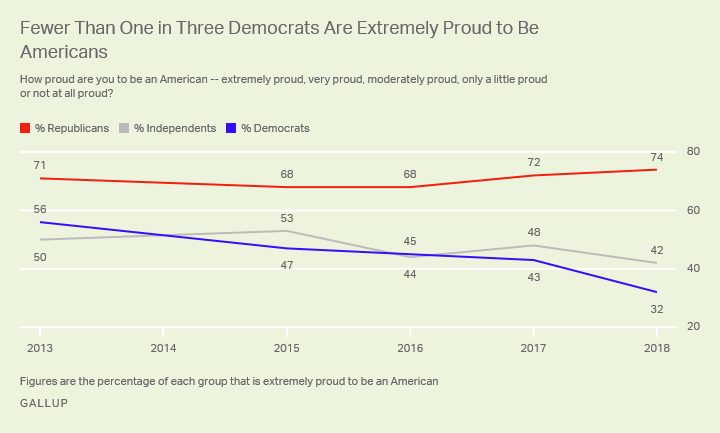
Further, the Republican party has gotten more conservative in the last several decades. In 1974, 45% of Republicans described themselves as conservative. In 2012, that number was 70%. About 75% of GOP primary voters describe themselves as conservative. (source, NY Times article ↗) Regardless of what anybody says, the GOP has moved further right ideologically, and that is represented in the GOP electorate and the GOP elected representation, all of which are further right now than they were in prior years.
Where the Democratic party has shifted is in the way in which it is represented. The Democratic caucus looks like the party itself - more minorities in office, more women, members of the LGBTQ community, etc.
This has the effect of making people feel that the party is moving further away simply because the party looks different. Bernie Sanders is pretty far left, politically. The govtrack report card ↗ rates him as the second most liberal member of the Senate, trailing only the now resigned Al Franken.
Yet if you asked people who they felt was most liberal, names like Elizabeth Warren (20th most liberal), Kamala Harris (8th most), Dianne Feinstein (15th most), Cory Booker (18th most) would come up.
What's even more notable about the report card is that 1.00 represents most conservative, while 0.00 represents most liberal, with .50 being perfectly centrist.
Guess who scores a .50 - Claire McCaskill (D-MO), who is being cast as enormously liberal in her current Senate race. Also notable, McCaskill is not the most conservative Democrat, and ranks 59th in the Senate in terms of being conservative. That means that, on the whole, the Senate is actually further right.
We can also look at the report card and see that only one GOP senator rates below a .60 (Susan Collins - ME). There are 9 Democrats that rank higher than a .40. The GOP is, on the whole, further right (51 of their 52 caucus members are .67 or higher). In the House, 230 Republicans have an ideology score of .57 or more, and no Republican is less than .46. For the Democrats, there are 24 with scores higher than .43, and several have scores above .50. Again, the GOP is further right than the Democrats are left.
There's really no factual basis to argue that the GOP has not moved further right, or that the GOP is closer to the center than the Democrats. Absolutely none.










 ↗
↗